
Bitcoin Cash Scaling — The Adaptive Blocksize Limit Algorithm
See how on-chain scaling with dynamic blocks works — what tests show, how decentralization holds up, and the "blockchain trilemma" put to rest
From fixed block caps to an adaptive algorithm (ABLA)
Blocksize changes in Bitcoin are manual hard-fork upgrades that require consensus, node coordination, and can become contentious. This is what happened with Bitcoin's 2017 upgrade to 8 MB blocks, which led to two chains and the upgraded one becoming the minority, continuing as Bitcoin Cash.
Later, a scheduled upgrade in BCH raised the blocksize limit to 32MB without controversy, but the changes were still manual events that depended on coordination.
With the development of the Adaptive Blocksize Limit Algorithm, this manual scaling step was removed: on May 2024, ABLA activated, replacing fixed limits with a dynamic, data-driven model.
How the Adaptive Blocksize Limit Algorithm works
ABLA automates blocksize adjustments using an exponentially weighted moving average (EWMA) of recent blocks. This allows proportional, predictable changes without governance intervention.
ABLA works much like a smart thermostat, adjusting temperature smoothly based on recent changes: it adjusts the blocksize limit based on activity, increasing when demand rises and holding steady when it does not.
Controlled long‑term growth
Under sustained high utilization, the permitted blocksize may increase gradually. Growth remains conservative and predictable, ensuring compatibility with network infrastructure and no rushed breaking changes.
Short‑term elasticity
During temporary spikes in transaction volume, ABLA provides limited upward flexibility to prevent congestion while maintaining low fees and zero-confirmation viability.
Data‑driven adjustment
Capacity changes only occur in response to measurable, sustained demand. In the absence of increased activity, the limit remains stable.
Stress‑test simulation
This chart illustrates how ABLA behaves under a simulated high‑demand scenario spanning approximately six years:
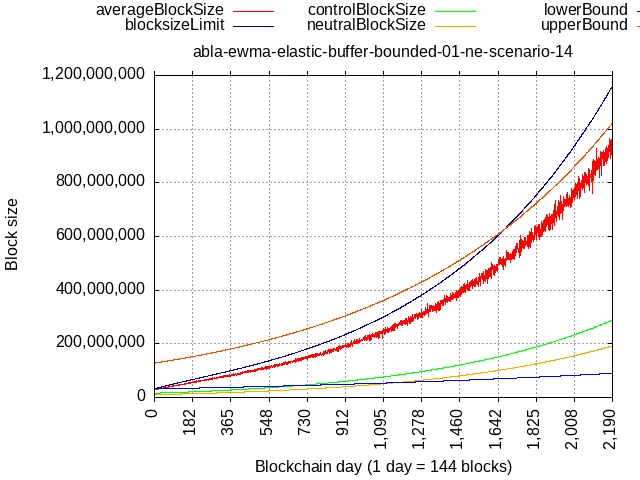
In this scenario, the limit approaches the 1 GB range only after several years of continuous high usage. This demonstrates controlled, data‑driven expansion and allows infrastructure ample time to scale alongside demand.
Implications of an adaptive block size
For users and operators, ABLA solves core fixed-capacity problems:
On-chain scaling and the blockchain trilemma
The “blockchain trilemma” is a common belief that a network cannot achieve decentralization, scalability, and security simultaneously. Many claim that large blocks lead to centralization by raising hardware requirements, therefore Bitcoin can’t scale on-chain.
In practice, modern technology advancements eliminate these concerns. While larger blocks do require more capable hardware to run a node, the cost remains on the order of a modern smartphone. A network with 10,000 well‑distributed nodes is no less decentralized than one with 50,000. Decentralization doesn’t depend on sheer node count; as long as a network cannot be taken over by a single entity or group, it is decentralized.
Furthermore, today’s mining (i.e., the nodes who write the ledger) is already a capital‑intensive, specialized operation due to ASIC hardware and energy consumption. The idea that every individual should be able to run a deciding node (mining node) on an old phone is unrealistic and ridiculous. Hardware requirements shouldn’t be kept artificially low if that means the network can barely process a few transactions.
The real centralization risk in Bitcoin (the protocol) is the necessity to reintroduce custodial intermediaries — and this is precisely what small blocks led to in the BTC chain.
Bitcoin’s security model long-term
The fundamental security model of Bitcoin, based on SHA-256 Proof-of-Work, is financed by block rewards and transaction fees. As halvings reduce the block reward toward zero, long-term security must increasingly be sustained by fee revenue.
This leads to two options:
The threat of inactive hashrate
If fee revenue becomes insufficient, active hashrate may fall while substantial global capacity remains idle. This creates a sharper risk: unused hashrate can grow to represent a larger share of the total available capacity than the portion actively securing the chain. When the inactive share of global hashrate becomes larger than the active portion, that dormant capacity could be reactivated or redirected to overpower the network, increasing vulnerability.
BCH sticks to the high throughput, low fees "global currency" model to secure the network.
In a few decades when the reward gets too small, the transaction fee will become the main compensation for nodes. I'm sure that in 20 years there will either be very large transaction volume or no volume.
— Satoshi Nakamoto, 2010
Readiness for broader adoption
As jurisdictions introduce CBDCs and push permissioned systems, the demand for freedom money will keep rising. When that happens, we expect crypto's paradigm to shift from today’s speculation toward global sound money.
With its Adaptive Blocksize Limit Algorithm, Bitcoin Cash is already operating as a working, parallel economic system — and is prepared to meet tomorrow's demand.