
How Bitcoin Cash Governance Works
Open, decentralized governance with no single authority — upgrades based on voluntary consensus among independent teams

Anyone can build and innovate freely; no permission is needed to build apps or services, use existing opcodes, create smart contracts, or port privacy technology like ZKP into VM logic. BCH does not gatekeep: it is neutral infrastructure.
On the other hand, Bitcoin Cash protocol upgrades follow an open, decentralized process driven by careful analysis, public review, and debate, allowing the community to approach protocol improvements in a structured and predictable way.
Cash Improvement Proposals (CHIPs) provide a common, transparent path for proposing and evaluating consensus-level changes. Only once a CHIP has been widely reviewed and accepted do independent node teams implement the upgrade.
This contrasts with most crypto projects, where a single “official” implementation or foundation decides which changes live and which don’t.
The CHIP upgrade process
A CHIP is a public document that defines one specific change to the Bitcoin Cash protocol — its motivation, expected benefits, risks, and technical specification. It also outlines the process for building agreement around that change, making the reasoning transparent to anyone who wants to evaluate it.
Anyone can propose a CHIP. In practice, proposals tend to come from contributors with a strong understanding of the protocol, because a CHIP must clearly describe how the change works and how it should be assessed. Its influence depends entirely on the strength of its reasoning and the support it earns. The default answer is "no" unless everyone is convinced.
Once a draft exists, discussion happens in the open: on forums such as bitcoincashresearch.org→, in code repositories, and in conversations among node teams, businesses, miners, and application developers. A well‑structured CHIP identifies its key stakeholders and seeks their feedback so that support or concerns are based on concrete, public arguments.
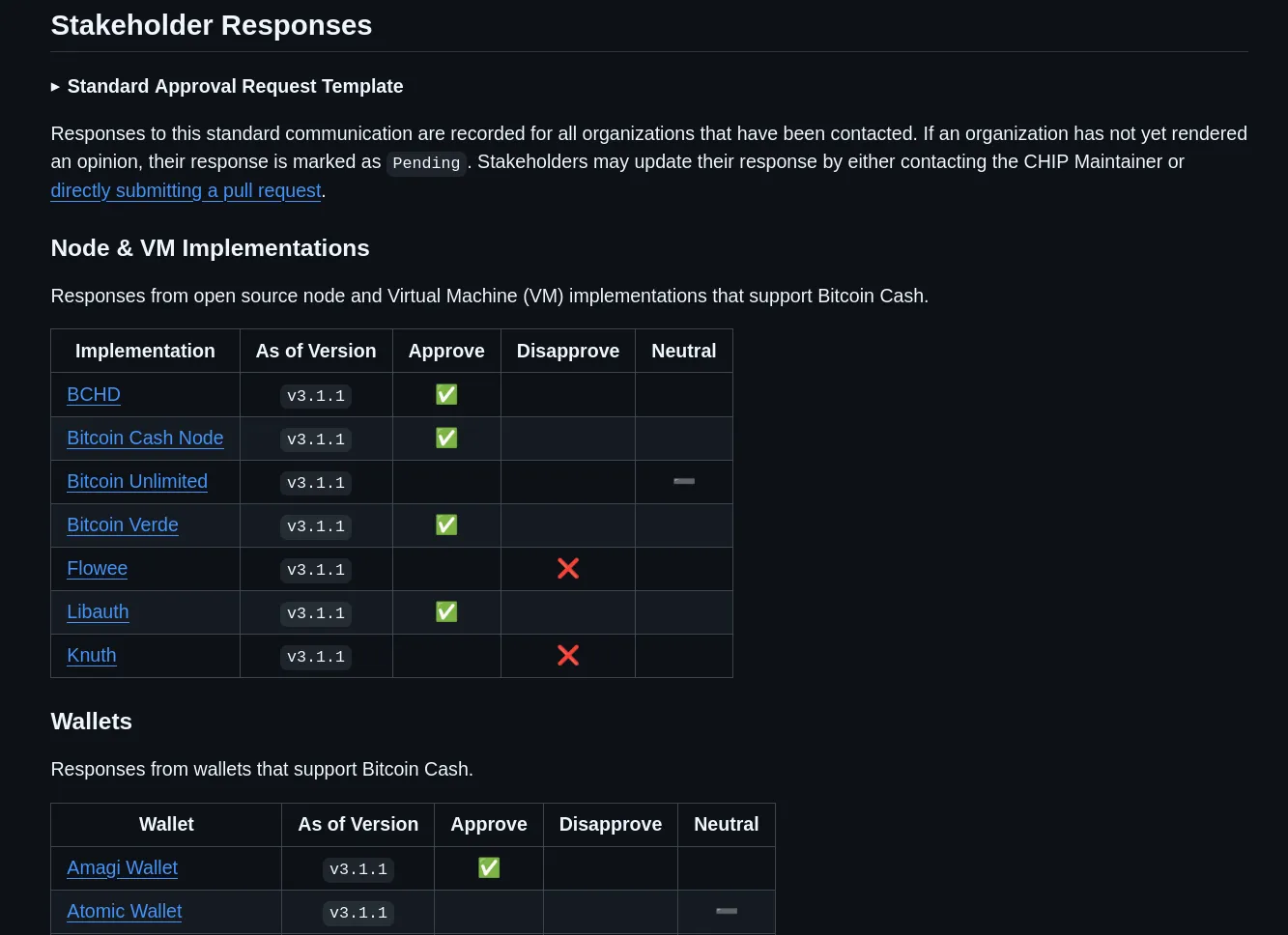
Stakeholders responses list in a CHIP. Source: bigints CHIP→
As the proposal matures, sections are clarified, risks addressed, and sometimes the idea is reduced in scope or merged with others. The goal is broad consensus.
A CHIP that fails to convince enough of the ecosystem does not activate. It may be reworked for a future cycle, or it may be abandoned altogether.
At a high level, the lifecycle of a CHIP is:
proposal → discussion → iteration → acceptance → implementation
The annual activation model
Bitcoin Cash follows a fixed upgrade rhythm: one main network upgrade per year, on May 15th. This annual activation concentrates protocol changes into a single, predictable moment instead of scattering them throughout the year.
Ahead of that date, the CHIPs selected for the upgrade are implemented on a
dedicated test network (chipnet) about six months before activation, giving node teams, wallets, and services time to test, integrate, and coordinate safely.
By keeping upgrades on a clear annual schedule, Bitcoin Cash reduces last-minute pressure, drama, and surprises that could break infrastructure.
Multiple independent node clients
Several teams maintain their own Bitcoin Cash node clients — there is no “official” implementation.




Each team maintains its own codebase and release process. Miners choose which software to use to mine and validate blocks with.
Because no client is “official,” real power sits with economic adoption. Implementations that consistently ship robust, well‑reviewed upgrades earn trust.
Proof of decentralization: main client rejected in 2020 (the eCash fork)
In 2020, the main Bitcoin Cash implementation, Bitcoin Cash ABC, proposed adding an Infrastructure Funding Plan to the protocol, now known as “dev tax”: 8% of every block reward would be redirected to a development fund they controlled. That rule was included in their client and they were to move forward with it as part of the November 2020 upgrade, despite broad disagreement.
Most of the ecosystem — other node teams, a large share of miners, and major services — rejected that change and continued to run software without the mandatory tax. When the upgrade date arrived, the network split: the chain enforcing the tax became a minority fork under the name Bitcoin Cash ABC (BCHA), later rebranded as eCash (XEC), while the main Bitcoin Cash chain carried on running other node clients without the dev tax, and with the bulk of the economic activity.
This episode showed how Bitcoin Cash governance works. Even a long‑standing “main” implementation cannot push through a change the ecosystem rejects. When a client insists on a contentious rule, the outcome is not that BCH is taken over — it simply results in it being rejected.
Frequently Asked Questions
No single person, company, or foundation controls Bitcoin Cash. Changes only matter if independent node implementations adopt them, and the wider ecosystem and miners choose to run that software.
Because Bitcoin Cash keeps Bitcoin’s original, decentralized peer-to-peer electronic cash design and vision. Bitcoin was born without a foundation or owners, and BCH is simply that same project continuing after the 2017 upgrade to 8 MB blocks — the name only changed because it had less hashrate at the time of the split. A foundation or core team would create a single point of control and a natural target for lobbying and capture. Instead, several independent node teams develop compatible clients, and CHIPs, together with the choices of miners, businesses, and users, determine which rules the network actually follows.
CHIPs are only for consensus-level protocol changes. The CHIP system is used when the protocol isn't capable enough and there's a proposal to implement a modification — a bold claim requiring evidence and broad ecosystem buy-in. The default answer is 'no' unless the proposer can convince the ecosystem.
Conflicts are usually discovered during public discussion and review. In practice, node teams and economic actors only adopt a set of changes they consider compatible and safe; conflicting proposals are reworked, postponed, or dropped.
Blockchains are always susceptible to a split. If incompatible rules are activated by different groups, any chain can split. The current BCH governance model aims to minimise that by favouring broad consensus, but it does not make contentious forks impossible.
They can fund development, run nodes, and mine blocks, but they cannot force others to adopt their preferred client. If they push changes the ecosystem rejects, the likely outcome is a minority fork — not control over Bitcoin Cash.
Bitcoin Cash will always be what majority hashrate decides it is — Nakamoto consensus.
In summary, Bitcoin Cash continued Bitcoin's original decentralized governance as sound money with no central authority.
In contrast, today's BTC chain is centrally controlled by Bitcoin Core — hence why the 2017 fork was needed.
You can learn more about this divergence on our page Why Bitcoin Cash.